GWAS

An array for any application. Any budget.

Illumina genotyping arrays provide an efficient and powerful toolset for examining the widest range of genetic variation. Whether you are conducting a large-scale GWAS study or providing genetic services as part of a commercial laboratory, Illumina's economical Infinium, GoldenGate, and VeraCode genotyping platforms combine industry-leading data quality, with the content flexibility to match any application.

Leading the Way for Array-Based Genetic Studies

Providing industry best data quality and content flexibility, the Infinium genotyping assay is the engine that powers the Omni family of whole-genome microarrays, targeted consortia microarrays, and our iSelect custom microarrays.

Since the Omni family of microarrays was launched in 2009, we've offered an expanding selection of flexible arrays featuring only the most informative common and progressively rare variants. Delivering the most powerful markers selected from the International HapMap and 1000 Genomes Projects. Built with input from thought leaders in the human genetics research community, to ensure these markers will effectively advance your studies.

At the same time, Illumina has succeeded in increasing the flexibility of our custom options. The Omni family of microarrays can be enhanced with hundreds of thousands of markers of custom content: what we call "semi-custom". Or, you can design your own microarray from the bottom-up using 48 to 1M SNPs.

The Genotyping Platform of Choice for Commercial Laboratories

In addition to providing industry-leading data quality, generating data on Illumina genotyping platforms is simple, flexible, and fast. Infinium and GoldenGate are 3-day assays from sample prep to data. Both can be fully automated enabling processing of hundreds to thousands of samples per week.  Illumina provides a range of automation options, LIMs systems, and data analysis solutions to make sure that data is generated and delivered on time.

Enabling Robust FFPE Sample Analysis

Millions of formalin-fixed paraffin-embedded (FFPE) archival cancer tissue samples provide an enormous and invaluable repository of information for cancer research. However, the fixation process and storage of FFPE samples frequently leads to nucleic acid degradation and base modification. To overcome this problem, Illumina has developed a FFPE sample restoration solution that provides a simple workflow to QC samples, repair damaged DNA, and achieve high-quality data using the Infinium HD Assay.

Cutting-Edge Array Scanners

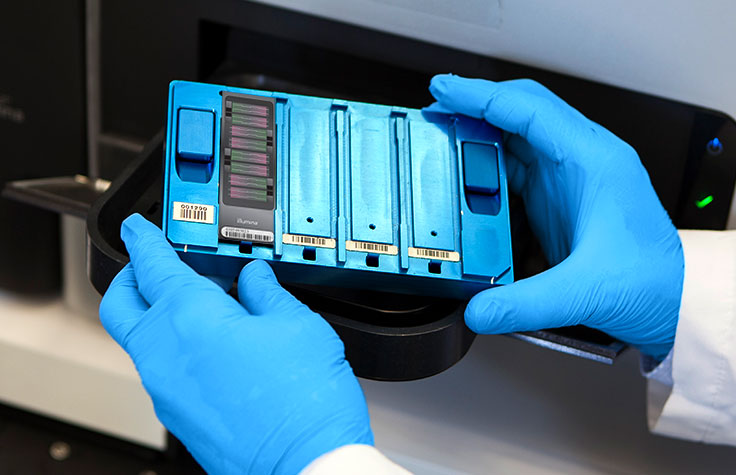
The HiScan and iScan systems are cutting-edge array scanners that support rapid, sensitive, and accurate imaging of Illumina BeadChips for industry-leading genetic analysis results. Both systems support Illumina's broad portfolio of innovative genetic analysis assays for genotyping, CNV analysis, DNA methylation, and gene expression profiling. For additional functionality, the HiScan system can be paired with supplementary modules to create a powerful platform, the HiScanSQ system, which integrates the power of next-generation sequencing with array analysis, enabling possibilities for richer discovery.

Next-Gen Sequencing and Microarrays
Explore hybrid workflow options »
Expand the power of your study—next-gen sequencing and arrays.
FFPE Video
Discover the FFPE Solution
Omni Microarrays Chip Selector
Launch the chip selector »
Select the best array for your research.
Infinium Assay
Discover the technology »
Watch the Infinium Arrays animation
Next-Generation GWAS eBook
Read the e-book »
Read about the evolution of Omni arrays.

Omni Family of Arrays

Use the Omni Family to access the speed, ease of use and cost effectiveness of microarrays, to achieve the statistical power you need for your whole-genome study. The Omni Family gives you the flexibility to study the widest range of genetic variation-no matter your study size, sample population, research focus, or budget. Get the most comprehensive coverage of common and rare variants with the Omni5. Or, start with common variants on the OmniExpress and dig deeper into the MAF range with additional Omni arrays as your study progresses.

Whichever Omni Array you choose, you are guaranteed to get the highest data quality, backed by the powerful Infinium Assay, with the highest-throughput, intelligent tag-SNP selection, and cutting-edge content. Making the most of what genomic research has revealed and giving you the power to make significant genome-wide discoveries.

LAUNCH CHIP SELECTOR

Omni Microarrays
BeadChipArray Format/
Sample Throughput
Markers per SampleCustom Marker Add-On CapabilityData Set Used for Content SelectionContent Description
HumanOmni5-Quad 4/460* 4.3 million

500,000 1000 Genomes Dec 2012 release
(MAF ≥ 1%)
Access the highest value content, plus 500K of your own.
HumanOmni5Exome 4/460* ~ 4.5 million

200,000 1000 Genomes Dec 2012 release
(MAF ≥ 1%), plus exome content selected from 12,000 individual exome sequences taken from various large sequence projects
The most powerful microarray. 4.3 million whole-genome variants down to 1% MAF, combined with novel functional exonic variants taken from over 12,000 sequenced exomes.
HumanOmni2.5-8 8/1067* ~2.5 million 200,000 1000 Genomes Project Pilot (MAF ≥ 2.5%) Common and rare variants targeting down to 2.5% MAF selected from the 1000 Genomes Project
HumanOmni2.5Exome 8/1067* ~ 2.7 million N/A 1000 Genomes Project Pilot (MAF > 2.5%), plus exome content selected from 12,000 individual exome sequences taken from various large sequence projects
Common and rare variants targeting down to 2.5% MAF selected from the 1000 Genomes Project, combined with novel functional exonic variants taken from over 12,000 sequenced exomes. 
HumanOmniExpress


12/1400* > 700,000
200,000 HapMap MAF ≥ 5% The most economical way to scan thousands of samples per week using optimized common tag SNPs.
HumanOmniExpressExome

8/960* > 900,000
30,000 HapMap MAF ≥ 5%, plus exome content selected from 12,000 individual exome sequences taken from various large sequence projects
The most economical way to scan thousands of samples per week using optimized common tag SNPs and novel functional exonic variants taken from over 12,000 sequenced exomes.

HumanOmni2.5S 8/1067* ~2.5 million
500,000 1000 Genomes Dec 2012 release
(MAF ≥ 1%)
Add novel data from the 1,000 Genomes Project to your Omni2.5 or OmniExpress study, covering MAF down to 1%. .
HumanOmni1S 8/960* ~1.1 million
N/A 1000 Genomes Project Pilot (MAF ≥2.5%)
Add novel data from the first releases of the 1,000 Genomes Project to your OmniExpress study, covering low MAF to ~2.5%.

*High throughput: 1FTE, 1 HiScan or iScan system, 2 Tecans, 1 Autoloader 2.x, 24 BeadChips/batch, 2 batches/FTE.

†Enabled for use with FFPE samples. Please see the Infinium DNA Restoration Solution for more information.

Custom Genotyping

Illumina offers a broad range of custom genotyping options including Infinium iSelect HD, GoldenGate, and VeraCode for flexible design of 48 to 1M variants. Convenient online tools and Illumina representatives are available to help you design and select your markers of interest, and choose the assay and customized products to best suit your study designs or commercial processes:

  • Customize by leveraging Add-On content with existing Infinium products based on:
    • New discoveries
    • Disease, population, or area of interest
    • Service offering differentiation
  • Design custom panels targeting specific traits and/or genes of interest for screening large sample sets
  • Enhance targeted validation or screening of samples through fully custom or semi-custom arrays (i.e. net merit, fingerprinting, candidate gene identification, fine mapping, etc.)
  • Design fully custom arrays for GWAS and genomic selection of species or populations not supported by standard products
  • Perform economical quality control and barcoding before proceeding with whole-genome sequencing and high density array applications (i.e. variant discovery, GWAS, etc).


LAUNCH CHIP SELECTOR

Custom Genotyping Microarrays
Custom BeadChipArray Format/
Sample Throughput
Content Supported (attempted beadtypes)Add-On CapabilityBeadtype or Oligo Success GuaranteeContent Description
iSelect HD 24/3456* 3,072 to 90,000
Up to 90,000 ≥ 80%
Fully custom content. Any SNP, any species.
iSelect HD 12/1728* 90,001 to 250,000
Up to 250,000 ≥ 80%
Fully custom content. Any SNP, any species.
iSelect HD 4/480* 250,001 to 1 million
Up to 1 million
≥ 80%
Fully custom content. Any SNP, any species.
GoldenGate
32/1440*
96 to 3,072
NA ≥ 80%
Fully custom content. Any SNP, any species.
VeraCode 96/1440*
48 to 384
NA ≥ 80% Fully custom content. Any SNP, any species.

*High throughput: 1FTE, 1HiScan or iScan system, 2 Tecans, 1 Autoloader 2.x, 24 BeadChips/batch, 2 batches/FTE/Tecan.
† Add-On content capability cannot exceed the total capacity ofthe BeadChip including the base content.

Consortia

With a consortium, members work together privately or publicly to advance the collective understanding of science and improve individual economics. Already there are consortia for a variety of purposes that Illumina coordinates, with members pooling resources. Everyone benefits.

Genotyping panels based on Illumina BeadChips are the foundation of more than 25 different consortia products, with new groups being formed every year. In the sections below, you'll learn about consortia BeadChips for human disease research that are currently available and public consortia BeadChips in development. Illumina also supports Agrigenomics consortia.

All Illumina BeadChips are designed to enable a broad range of applications to accelerate and enhance research, advance the development of high-value content, and enable the swift deployment of discoveries in the real world.

If you'd like to participate in consortia or are interested in starting a new one, fill out the Human Disease Research Consortia interest form or contact your Illumina representative. More information on consortia for human disease research is contained in the Human Consortia FAQ.

HumanExome BeadChip

Developed by an international team of thought leaders in human genetics, the HumanExome BeadChip delivers > 250,000 putative functional exonic mutations identified from over 12,000 individual exome and whole-genome sequences.  Markers were identified through a close collaboration with leading geneticists with the goal of developing an extensive catalog of exome variants. The exonic content represents diverse populations-including European, African, Chinese, and Hispanic individuals-and a range of common conditions, such as type 2 diabetes, cancer, metabolic, and psychiatric disorders.

The HumanExome BeadChip also has capacity for Add-On content of up to 200K additional custom markers, allowing you to customize your exome-focused study with additional variants of specific importance to your research.  Similarly, the content of the HumanExome BeadChip can be included as add-on to any of our Omni Family of whole-genome arrays, combining genome-wide discovery with focused power within exonic regions.

HumanExome BeadChips Data Sheet

Human Exome Consortium Wiki Page

Human Cancer BeadChip

Designed to target regions of the genome implicated in reproductive cancers, the Human Cancer BeadChip (a.k.a. the iCOGS Chip) was developed by a consortium of leading cancer researchers in the US and Europe.  Access to this array is by permission of the consortium only.  For more information and to petition to join the consortium, please contact Doug Easton (dfe20@medschl.cam.ac.uk) or Nils Schoof (nils.schoof@ki.se).

COGS website

Human Immuno BeadChip

The Human Immuno BeadChip is a consortium-based, custom Illumina Infinium HD genotyping array, designed to target variants of interest in 12 immunologically related human diseases.  The array design integrates relevant 1000 Genomes data, disease-specific resequencing data, and known immune-mediated disease loci identified by common variant GWAS.

The final design incorporates 186 distinct loci containing markers meeting genome wide significance criteria (P<5x10⁻⁸) from twelve diseases (autoimmune thyroid disease, ankylosing spondylitis, Crohn's disease, celiac disease, IgA deficiency, multiple sclerosis, primary biliary cirrhosis, psoriasis, rheumatoid arthritis, systemic lupus erythematosus, type 1 diabetes, and ulcerative colitis). All 1000 Genomes Project pilot CEU population variants (Sept 2009 release) within 0.1cM (HapMap3 CEU) recombination blocks around each GWAS region index SNP were submitted for array design. This was augmented with additional case/control resequencing data alongside limited  investigator-specific wildcard content.

The Human Immuno BeadChip also has capacity for Add-On content of up to 25K additional custom markers, allowing you to customize your study with additional variants of specific importance to your research.

Human Cardio-Metabo BeadChip

The Human Cardio-Metabo BeadChip was designed by representatives from GWAS meta‐analysis Consortia, including CARDIoGRAM (coronary artery disease), DIAGRAM (type 2 diabetes), GIANT (height and weight), MAGIC (glycemic traits), Lipids (lipids), ICBP‐GWAS (blood pressure), and QT‐IGC (QT interval). It supports genotyping of SNPs selected according to five sets of criteria:

  1. Individual SNPs displaying evidence for association in GWA meta‐analyses to diseases and traits relevant to metabolic and atherosclerotic‐cardiovascular endpoints
  2. Detailed fine mapping of loci validated at genome‐wide significance from these meta‐analyses
  3. All SNPs associated at genome‐wide significance with any human trait
  4. "Wildcards" selected by each meta‐analysis Consortium for Consortium‐specific purposes
  5. Other useful content, including SNPs that tag common CNPs, SNPs in the HLA region, that mark the X and Y chromosomes and mtDNA, and needed for sample fingerprinting (common SNPs represented on major genome‐wide array products from both Illumina and Affymetrix)

Details of all these SNP sets can be found in the Metabo-Chip Consortium letter.

The Human Cardio-Metabo BeadChip also has capacity for Add-On content of up to 25K additional custom markers, allowing you to customize your study with additional variants of specific importance to your research.


Literature and Resources

Next-Gen Sequencing and Microarrays
Explore hybrid workflow options »
Expand the power of your study—next-gen sequencing and arrays.
FFPE Video
Discover the FFPE Solution
Omni Microarrays Chip Selector
Launch the chip selector »
Select the best array for your research.
Infinium Assay
Discover the technology »
Watch the Infinium Arrays animation
Next-Generation GWAS eBook
Read the e-book »
Read about the evolution of Omni arrays.

Grant Resource

Identifying and pursuing grant awards is a time-consuming, yet vital activity for academic researchers. As a resource for the latest funding opportunities, this web page provides research grant information where whole-genome, exome, variant discovery, or gene identification studies might be required and suggests the Illumina BeadChips and systems that will yield the high quality results necessary to successfully complete the project.

Mechanisms of Alcohol-Associated Cancer
Submission Date: May 5, 2012
Illumina products:
Organization: National Institutes of Health (NIH) 
FOA Number: PA-12-146
Earliest Start Date: April 2013

This FOA issues by the National Institute on Alcohol Abuse and Alcoholism (NIAAA) and the National Cancer Institute (NCI) invites applications from researchers with broad ranges of expertise to study the mechanisms by which alcohol increases cancer risk.

Alcohol has been classified as carcinogenic to humans by the International Agency for Research on Cancer (IARC). Target sites for alcohol-related carcinogenesis include the oral cavity, pharynx, esophagus, larynx, breast, liver, and colon. A better understanding of the molecular basis by which alcohol increases cancer risk could lead to improved therapeutic approaches and preventative strategies and would provide guidance on safe levels of alcohol consumption. The goal of this program announcement is to stimulate a broad range of research into the mechanisms by which alcohol contributes to carcinogenesis.