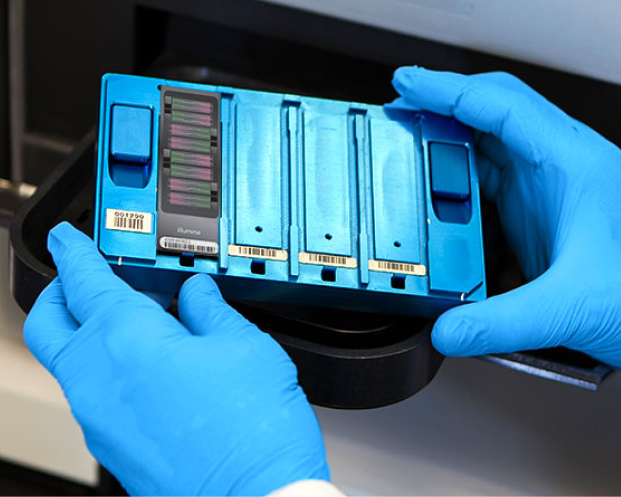
Since they were first developed in 2005, whole-genome genotyping (WGGT) arrays have become an important tool for discovering variants that contribute to human diseases and phenotypes. The two primary applications of this technology, genome-wide association studies (GWAS) and copy number variant (CNV) analysis, have helped researchers begin to unravel the complex genetic architecture behind diseases such as diabetes and Crohn's disease, and traits such as hair and eye color.
Illumina's WGGT Infinium BeadChips offer researchers the flexibility to genotype samples with hundreds of thousands to millions of markers that deliver dense genome-wide coverage with the most up-to-date content available from the scientific community. Markers on the BeadChips are strategically selected by Illumina scientists to provide maximum coverage of the genome for both association testing and copy number detection.
Keep up-to-date with recent discoveries by customizing Infinium iSelect HD BeadChips with Infinium Add-On Content. Whether it comes from publically available databases or new discoveries, allows researchers to combine existing marker sets with new, unique content on a single BeadChip, increasing efficiency and cost effectiveness in study design.
The Omni Family of Microarrays
The latest generation of Infinium WGGT products is The Omni Family of Microarrays. This flexible, complimentary family of microarrays represents a revolution in array design, delivering up to 5 million makers per sample and offering an unprecedented amount of customizability. Designed from next-generation sequencing data from international projects such as the 1000 Genomes Project, Omni microarrays deliver unrivaled coverage of the genome. Access to whole-genome sequencing data provides the most complete picture of the extent of variation, allowing Illumina scientists to select the most informative markers to provide superior power to detect trait- and disease-associated variants.
Learn More about the Omni Family of Microarrays
| BeadChip | Array Format | Markers per Sample |
|---|---|---|
| HumanOmni5-Quad | 4 | ~ 4.3 million |
| HumanOmni2.5S | 8 | ~ 2.5 million |
| HumanOmni2.5-8 | 8 | ~ 2.5 million |
| HumanOmni1S | 8 | ~ 1.25 million |
| HumanOmniExpress | 12 | ~ 700,000 |
| HumanCytoSNP-12 | 12 | ~ 300,000 |
| BeadChip | Array Format | Markers per Sample |
|---|---|---|
| HumanOmni5-Quad+ | 4 | ~ 4.3 million (fixed) up to 500K (custom) |
| HumanOmni2.5S+ | 8 | ~2.5 million (fixed) up to 500K (custom) |
| HumanOmniExpress+ | 12 | ~700,000 (fixed) up to 200K (custom) |
For researchers who want to study focused genomic regions of interest, or are interested in organisms for which there are no standard products, Illumina offers a broad range of custom genotyping options. Customized iSelect BeadChips can be easily developed to fit any experimental design, allowing customers to select the ideal solution for their loci multiplexing and sample throughput requirements. Convenient online tools and Illumina representatives are available to help you design and select your markers of interest, and choose the assay and customized products to best suit your research goals.
Any iSelect HD Custom or Semi-Custom Infinium HD BeadChip can be further customized with Infinium Add-On Content. Whether content comes from publically available databases or recent discoveries, Add-On Content allows researchers to combine existing marker sets with new, unique content on a single BeadChip, increasing efficiency and cost effectiveness in study design. Convenient online tools and Illumina representatives are available to help you design and select your markers of interest, and choose the assay and customized products to best suit your research goals.
The iSelect HD Custom Genotyping program enables easy, versatile design of custom arrays to investigate markers targeting:
Illumina's fully custom genotyping platform offers all of the benefits of standard Infinium products, including industry-leading data quality and call rates, streamlined workflow, and rational SNP selection with access to the entire genome of any species.
Access the enhanced multiplexing capabilities of the Infinium HD Assay on the 24-sample (3,000 to 90,000 attempted bead types), 12-sample (90,000 to 250,000 attempted bead types), or the 4-sample (250,000 to 1,000,000 attempted bead types) format BeadChips.
Focused genotyping supports a variety of applications such as candidate-gene studies in cancer, cardiovascular disease, and admixture mapping. Illumina also works closely with major animal consortia to develop genome-wide genotyping products for non-human organisms, including both animal and plant species.
For focused content, Infinium BeadChips feature the same design as the whole-genome Infinium DNA Analysis BeadChips and are powered by our proven, PCR-free Infinium Assay. A number of standard focused content Infinium BeadChips are available. To keep up-to-date with recent discoveries, these BeadChips can be customized with Infinium Add-On Content, enabling existing marker sets to be combined with new, unique content on a single BeadChip to increase the accuracy and cost effectiveness of study design.
Agrigenomics
Illumina offers variety of standard GoldenGate focused content panels and the option to design your own GoldenGate Custom Panel for a wide range of genomes and experimental strategies. GoldenGate panels can be deployed on 32- and 12-sample Universal BeadChips.
Structural variability is a substantial source of genetic variation that has a major influence on phenotypic variation. Cytogenetic analysis allows researchers to profile chromosomal aberrations such as amplifications, deletions, rearrangements, point mutations, copy number changes, and copy-neutral loss of heterozygosity (LOH) events.
Illumina offers a broad portfolio of genome-wide analysis BeadChips that enable researchers to analyze structural variation at varying levels of detail, from routine cytogenetic screening to sample profiling with up to 1.2 million markers.
Illumina's revolutionary Infinium HD technology allows for the selection of any SNP or probe, enabling dense, uniform coverage across the genome and the ability to target any genomic region. Infinium whole-genome arrays support high-resolution copy number and LOH analysis with median marker spacing as low as 1kb.
The Infinium Assay simultaneously measures intensity differences and allelic ratios, enabling the profiling of intercellular mosaicism and copy-neutral LOH events such as uniparental disomy (UPD), mitotic recombination, or gene conversion events, all of which cannot be detected on array-CGH platforms.
Analysis of Infinium HD BeadChip data is supported by Illumina's BeadStudio Genotyping Module and the standalone KaryoStudio data analysis software package, which was specifically designed by and for molecular cytogeneticists. In addition, through the illumina•connect program, Illumina data can be analyzed using common cytogenetics analysis programs.
Linkage analysis provides researchers a powerful method for mapping the location of disease-causing loci by identifying genetic markers that are co-inherited with a phenotype of interest. Illumina's linkage analysis BeadChips present the optimal solution for identifying regions of statistically unequivocal linkage by delivering the information content, call rates, and accuracy that enable discovery of links between familial genotype and phenotype in both monogenic and polygenic disorders.
Available with the GoldenGate Assay, the HumanLinkage V Panel Set is optimized to detect recombination events. Linkage analysis is a powerful approach for mapping the location of disease-causing loci. The 6,056 HumanLinkage V Panel SNP markers were chosen from highly validated HapMap DNA assays to optimize information content, enabling researchers to extract the greatest amount of data from the least number of markers.
For mouse genetics applications, two Mouse Linkage Panels — Mouse Low Density (LD) Linkage and Mouse Medium Density (MD) Linkage — are available. Both single nucleotide polymorphism (SNP) panels offer a low-cost, efficient method for attaining genome-wide genetic data to identify quantitative trait loci (QTLs), map candidate genes, and increase genotyping throughput. SNP sequences are optimized for Illumina's proven BeadArray Technology.
DNA methylation plays a critical role in the regulation of gene expression and has been implicated in the etiology of many human diseases including cancer. Methylation profiling with BeadArray technology allows researchers to analyze the effects of aberrant methylation (either hyper- or hypomethylation) for a variety of applications. Illumina has developed a robust methylation profiling platform that provides quantitative methylation measurement at the single-CpG-site level, providing the highest resolution for understanding epigenetic changes.
With Infinium Methylation Assays, researchers can quantitatively interrogate methylation sites at single-nucleotide resolution, profiling up to 12 samples in parallel to deliver high-throughput power while minimizing the cost per sample. The HumanMethylation27 BeadChip lets researchers interrogate 27,578 CpG loci, covering more than 14,000 genes. The HumanMethylation450 BeadChip offers a unique combination of comprehensive, expert-selected coverage of >450,000 methylation sites, high throughput, and low price, making it ideal for screening genome-wide association study (GWAS) populations.
RNA sequencing has revolutionized the exploration of gene expression. Advances in the sequencing workflow, from sample preparation through data analysis, enable rapid profiling and deep investigation of the transcriptome. With RNA sequencing, you can characterize all transcriptional activity, coding and non-coding, in any organism without a priori assumptions.
Illumina's unique combination of long and short reads, single and paired-end sequencing, strand specificity, and capacity for tens of millions to billions of reads per run allows you to...
With the greatest daily output available for any sequencing system, transcript profiles can be generated in a single day. RNA sequencing reads can be aligned across splice junctions to identify isoforms, novel transcripts and gene fusions. Identify and quantify both rare and common transcripts, with over six orders of magnitude of dynamic range. Reveal the hidden world of non-coding RNA architecture without prior information.
Formalin-fixed, paraffin-embedded (FFPE) samples are preserved tissue samples that are generally associated with disease. Many of these samples represent clinical outcomes, which could provide a potential gold mine of information when linked with underlying expression profiles. FFPE samples generally contain partially degraded RNA, so transcription analysis is a challenge for many gene expression assays. By using unique PCR and labeling steps based on the proven GoldenGate chemistry, Illumina's DASL assays provide high-quality data from degraded RNA samples. The DASL assay is available in the Whole-Genome DASL Assay, a fixed content, whole-genome profiling panel.
Covering more than 29,000 transcripts, the Whole-Genome DASL HT Assay is ideal for high-multiplex whole-genome profiling from FFPE samples. The assay combines the unique PCR and labeling steps of the original DASL assay with gene-based hybridization and the whole-genome probe set of Illumina's Direct Hybridization Assay. The product delivers high sensitivity and highly reproducible results from as little as 10–100 ng total RNA from fresh-frozen tissue or 50–200 ng total RNA from FFPE samples. The Whole-Genome DASL HT Assay obtains high concordance with qPCR at a low per sample cost compared to other methods.