Informatics Products

Streamlined
Enable greater efficiency from your tertiary analysis workflows with explainable AI (XAI) and automation for WGS, WES, virtual panels, and targeted panels.

Integrated
Unify your laboratory and NGS instrumentation with your health IT systems to simplify and secure your complete workflow.

Powered for Growth
Confidently keep pace with evolving science, technology, and demand with up-to-date knowledge graph and curation capabilities.
We Help You

Scale Volume
Increase throughput without increasing headcount using explainable AI (XAI) and automated workflows.

Expand Menu
Broaden your analysis to WGS or WES or standardize panels on a backbone assay and analyze various variant types – SNV, Indel, CNV, mtDNA, SV, and STR variants.

Launch Assays
Implement a high throughput WGS, WES, virtual panel, or targeted panel workflow that is integrated into your lab's digital ecosystem.

Share Curated Knowledge
Leverage the power of collaboration to share knowledge across a private network of labs.
Key Features
Connected Insights – Germline
Explainable AI (XAI)
Never a black box. XAI functions to help make insights prioritization suggestions, with evidence-backing, increasing workflow efficiency and confidence.
Automation
Maximize efficiency and scale by optimizing workflows for your standard operating procedures (SOPs) across test types and locking in your automated flow.
Powerful API Interoperability
Integrate workflows with application programming interfaces (APIs), linking your tertiary analysis with laboratory information management systems (LIMS), storage, pipelines, and more.
Software Preview
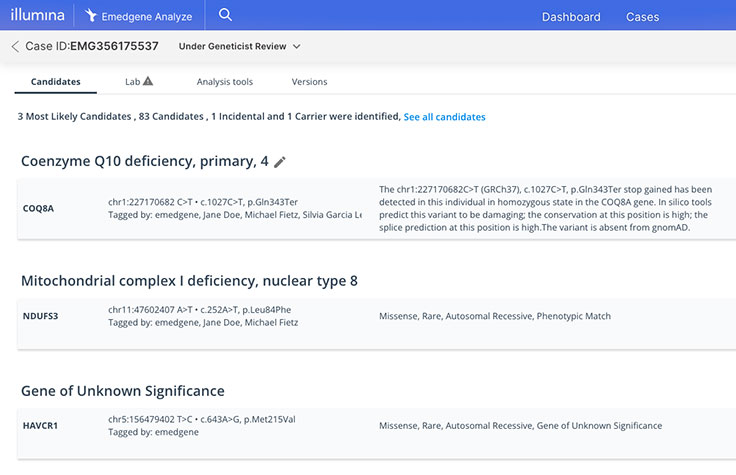
97% accuracy in prioritizing relevant insights, AI can suggest variants in complex cases that typically require hours of manual review.
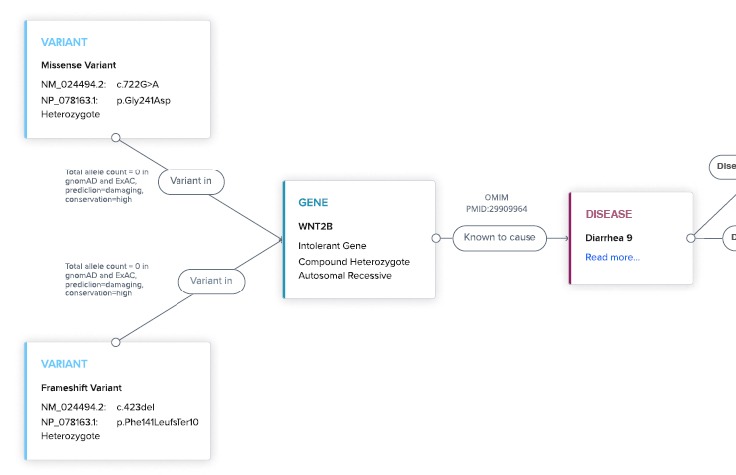
Never a black box, every AI hypothesis is backed by evidence collected from literature and databases.
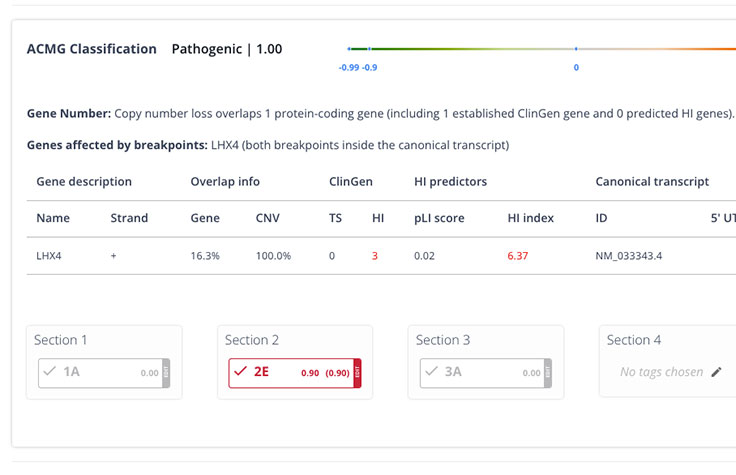
Time-saving automated ACMG classifications for SNV, indel, CNV and SV deletions/duplication variants.
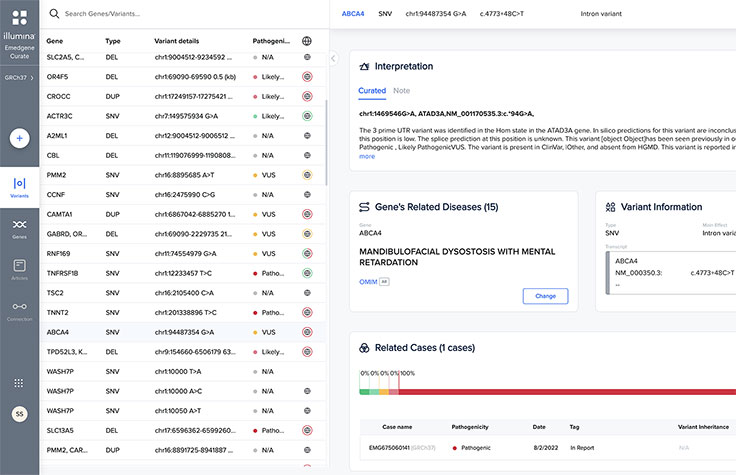
Maximize use and reuse of your organization’s curated knowledge. Share across a private network of connected labs.
Product Content
Brochure: Illumina Connected Insights – Germline
Understand how automating insights can help you confidently scale your data operations.
Data Sheet: Illumina Connected Insights – Germline
Overview of the automated insights solution with AI-optimization that can streamline dry lab workflows for WGS, WES, virtual panels, and targeted panels.
Application Note: Illumina Connected Insights – Germline
Learn more about explainable AI (XAI) for insights prioritization that automatically curates relevant evidence.
Customer Testimonials
"The platform helped us to pick up strong candidate variants in genes with no previously known phenotype from the sequencing data."
Dr. Lina Basel-Salmon
Head of the Institute of Genetics at the Beilinson Hospital
Read Article
THOUGHT LEADERSHIP
Breaking the Interpretation Bottleneck
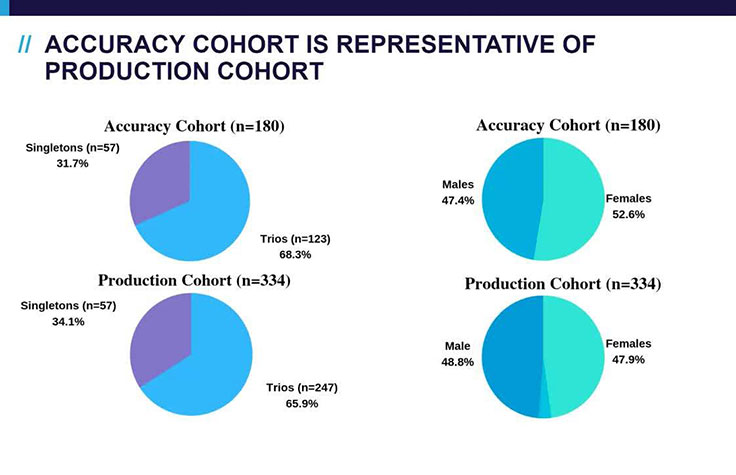
Dr. Linyan Meng, Division Director Clinical Interpretation, Baylor Genetics, presents the results of a joint Baylor Genetics-Emedgene (and now under new brand name with Illumina, Connected Insights – Germline) study demonstrating the utility of machine learning for interpretation in a 180-case cohort. By automating the variant prioritization and classification processes, machine learning technologies can unblock the genomic interpretation bottleneck.
Watch WebinarKey Applications
Whole-Genome Sequencing (WGS)
WGS is the most comprehensive method for genetic disease testing and is increasingly applied to rare disease and other hereditary disease research for NICU cases and beyond.
Learn MoreVirtual Panels
Virtual panels or “slices” can be created from a more comprehensive “backbone” assay that is standardized in the lab, such as WGS or WES.
Learn MoreWhole-Exome Sequencing (WES)
WES evaluates the exons, or coding regions of the genome. WES can also serve as a standardized backbone assay for virtual panels.
Learn MoreTargeted Sequencing
Analyze specific genes that are important for a hereditary disease or condition.
Learn MoreRelated Solutions
Advancing Genetic Disease Testing
NGS technology is helping to drive breakthroughs in genetic disease testing by facilitating early detection and diagnosis.
Future of NGS in Oncology
Next-generation sequencing provides deep insights into the molecular underpinnings of tumors and can help advance the promise of personalized medicine.
Related Products
BaseSpace Clarity LIMS
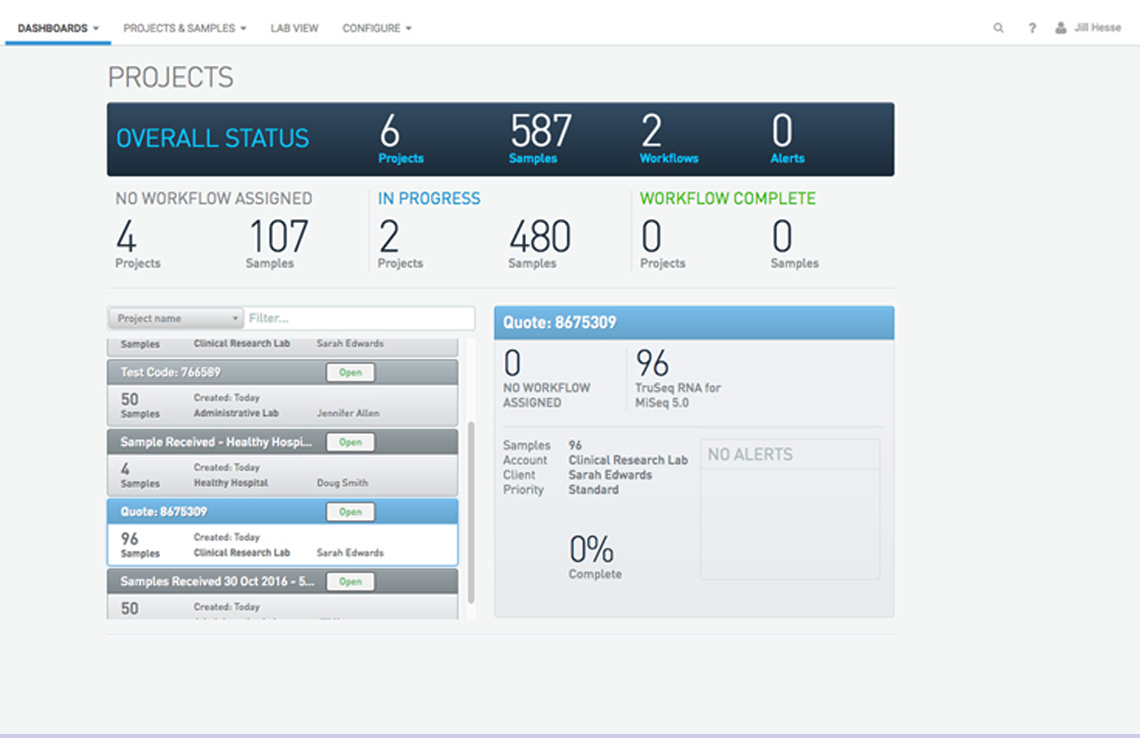
BaseSpace Clarity LIMS is a laboratory information management system designed for genomics labs to track samples and manage workflows for an optimized and efficient lab.

DRAGEN Bio-IT Platform
Illumina DRAGEN (Dynamic Read Analysis for GENomics) Bio-IT Platform provides accurate, comprehensive, and efficient analysis
Illumina Connected Analytics
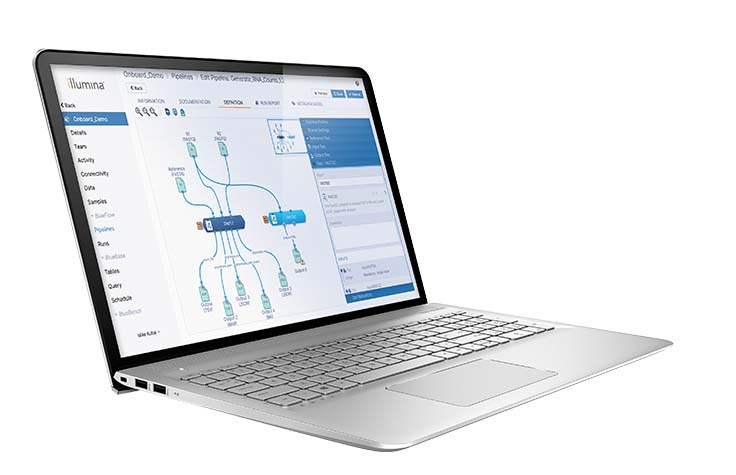
A secure genomic data platform to operationalize informatics and drive scientific insights.
Ready to Connect with a Genomic Scientist?
Discuss your workflow to learn how you can streamline your NGS operations and power your lab for growth using Connected Insights – Germline.
Speak to a Scientist