September 3, 2026
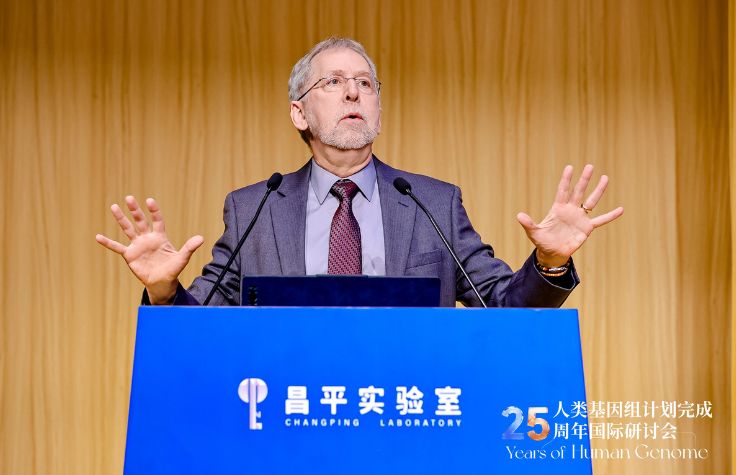
The “25 Years of Human Genome” International Symposium was held last month at Changping Laboratory in Beijing, bringing together scientists, research leaders, and industry partners from around the world to reflect on the progress and future of genomics. Among the invited speakers was Eric Green, MD, PhD, chief medical officer of Illumina and former director of the US National Human Genome Research Institute (NHGRI). Drawing on his experience as a leader in the Human Genome Project, Dr. Green shared his perspective on the field’s evolution, from the launch of the project to the growing integration of genomics into clinical practice.
A quarter century after the first draft human genome sequence was announced, how far has genomics taken us, and what will define its next chapter?
Understanding the blueprint of life
Since the publication of the first human genome, sequencing technology has advanced at an exponential pace, with costs falling faster than Moore’s Law and sequencing that once required years of coordinated effort now achievable in hours. In 2025, the volume of data generated globally on Illumina sequencing platforms per minute was equivalent to more than ten whole human genomes.
As genomics moved from bench to bedside, some of its earliest applications emerged in reproductive health and oncology. Non-invasive prenatal testing, comprehensive genomic profiling, and molecular residual disease detection have provided practical foundations for precision medicine. In the field of genetic diseases, the number of conditions with known genetic causes has grown from just 611 at the launch of the Human Genome Project (HGP) to more than 6,0002 today, enabling more diagnoses while advancing our understanding of disease and potential therapies.
Translating innovation into health impact
Since the HGP, progress in genomics has spanned the globe. In China, applications have been driven by real and pressing medical needs. In rare diseases and other complex conditions, more comprehensive, high-quality, and locally relevant molecular information is helping clinical teams better understand disease, identify underlying causes, and explore personalized approaches to diagnosis and treatment.
During his visit, Dr. Green and the Illumina China team met with a local partner to discuss challenges in rare disease research, as well as ongoing efforts to build a collaborative rare disease network and explore the potential applications of artificial intelligence.

Dr. Green noted that the value of clinical genomics lies in translating genomic information into meaningful insights for disease prevention, diagnosis, and treatment. Illumina will continue to introduce advanced technologies, facilitate the sharing of global experience, and support users in China in strengthening rare disease research and advancing its development.
The role of openness, collaboration, and AI
China’s Government Work Report 2026 identified biomedicine as an emerging industry, as China’s pharmaceutical innovation becomes increasingly integrated into the global R&D ecosystem. As pioneering technologies including AI advance rapidly, improving R&D efficiency and strengthening the use of clinical data and building capabilities for global development are key priorities.
During the visit, Dr. Green met with the China Pharmaceutical Innovation and Research Development Association (PhIRDA) and industry partners to discuss homegrown innovation and the global development of China’s pharmaceutical sector. Ruilin Song, Chief Expert of PhIRDA, said that as AI is reshaping pharmaceutical innovation globally, China needs stronger frameworks for clinical data access and governance to unlock the full potential of its clinical resources.

Song emphasized that regulatory globalization is essential to the development of China’s pharmaceutical industry. Scientific data, he noted, provide a common language for regulators worldwide, while greater regulatory alignment can support Chinese medicines in reaching global markets.
Drawing on the experience of the HGP, Dr. Green noted that transparency, openness, and international collaboration are also essential. Addressing emerging challenges in data, AI, and complex disease research will require countries to share expertise and work together to ensure that technological progress benefits more people.
Reflecting on his discussions with Chinese scientists and industry leaders, he highlighted China’s growing strengths in AI, computational science, and computer engineering, and the potential for these capabilities to contribute to global efforts in life sciences and health.
Inspiring the next generation of scientists
Continued progress in genomics depends not only on technological advances and cross-disciplinary collaboration, but also on the participation of young researchers. As genomics increasingly intersects with AI, computational science, and clinical medicine, interdisciplinary capabilities will be essential.
In April 2026, Illumina and the Genome Sequencing and Analysis Facility of the Technology Center for Protein Sciences at Tsinghua University jointly launched the two-year IMPACT (Innovative Life Sciences and Medical Practice Training) Program. The program integrates multiomics technologies into higher education and research practice, combining lectures on emerging technologies with hands-on training to help early-career researchers build capabilities across the research workflow, from experimental design and sequencing to data analysis and insight generation.

During an event at Tsinghua University, Dr. Green met with faculty members and students. He encouraged students to maintain an interdisciplinary perspective and seek opportunities for innovation at the intersection of fundamental research and real-world challenges.
Creating new possibilities
A quarter century ago, the first draft human genome sequence opened a new era in our understanding of life’s blueprint. Today, scientists around the world face a new challenge: translating genomic discoveries into meaningful health benefits.
“The Human Genome Project demonstrated that major scientific breakthroughs are built on collaboration across disciplines and borders,” said Dr. Green. “As we work toward a future in which more people can benefit from genomics, continued technological progress, international collaboration, and knowledge sharing will all be essential. China is creating new possibilities for the next phase of genomics, and I look forward to seeing its experience and innovations contribute to global science and human health.”
References
1Bamshad MJ, Nickerson DA, Chong JX. Mendelian Gene Discovery: Fast and Furious with No End in Sight. Am J Hum Genet. 2019 Sep 5;105(3):448-455. doi: 10.1016/j.ajhg.2019.07.011. PMID: 31491408; PMCID: PMC6731362.
2Wakap S, Lambert DM, Orly A, et al. Europ J Hum Genet.2019: https://doi.org/10.1038/s41431-019-0508-0.


