December 12, 2025
Infertility is never just a diagnosis—it’s a deeply personal journey. For Dr. Yaron Goikhman, an obstetrician-gynecologist and reproductive medicine specialist, this journey became personal in 2021 when he and his wife decided to pursue in vitro fertilization (IVF), a procedure that helps couples conceive.
The process produced five embryos, which underwent preimplantation genetic testing for aneuploidy (PGT-A). The results seemed to show that only two embryos were considered viable, meaning the other three embryos showed evidence of chromosomal anomalies. But something didn’t feel right. Goikhman later retested the three embryos in his laboratory and found that two of them appeared viable. There are several explanations for this difference, but for Goikhman and his wife, the information changed everything. It provided them with more hope for a successful outcome.
“It’s tough for families to trust PGT results,” he says, “yet they make life-altering decisions based on those results.” The process of undergoing IVF is emotional, difficult, and costly, so the more embryos available to transfer, the better the chance for a couple to achieve their dream of a healthy pregnancy.
From local to global
Based in Tashkent, Goikhman wants to provide families in Central Asia with access to safe and modern genetic tools. Certain genetic conditions, such as thalassemia and spinal muscular atrophy, are known to be more prevalent in this region. Families where both parents are known carriers for certain genetic conditions may seek options to limit the chances of having an affected child.
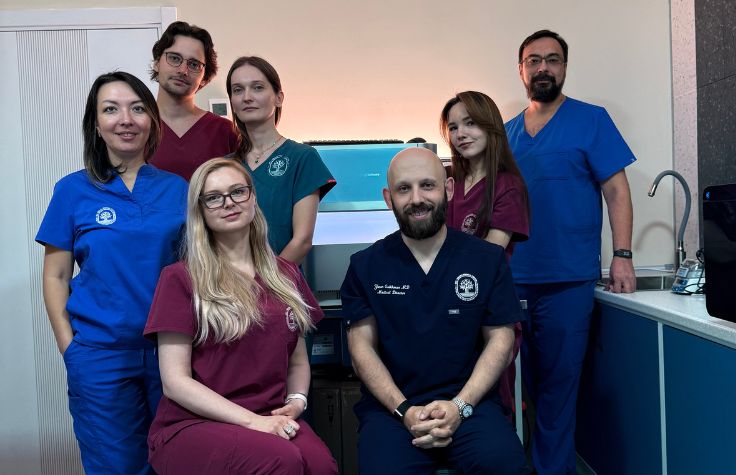
His work requires collaborating with outstanding experts such as Svetlana Avdeichik, a genetics specialist, and Andrey Kuliev, an embryologist-geneticist. With their instrumental expertise and dedication, and by scaling up operations with Illumina sequencers that enable high-throughput PGT, noninvasive prenatal testing, and whole-exome sequencing, he envisions improving access to PGT worldwide. Each step has pushed the boundaries of what’s possible.
Changing lives, one family at a time
Behind the technology are stories of resilience and hope. Goikhman mentions one mother who, after losing three children to spinal muscular atrophy, was desperate for answers. PGT can be performed for either aneuploidy (PGT-A) or monogenic conditions (PGT-M). With access to PGT-M, she conceived and delivered a healthy baby girl—her first child who was free of the disease.
Goikhman says none of this would be possible without a team of geneticists, embryologists, and reproductive specialists working side by side: “Their combined expertise helps ensure that every test is not just a lab result, but a step toward giving families new possibilities.”
“Our mission is to build healthier generations everywhere,” Goikhman says. “Genetics is not just a tool; I see it as the future of medicine and the only way forward is upward. When it comes to helping families build their future, the only direction is to shoot for the stars.”